In a pair of worn jeans, the new thread can be the strongest thing in the repair. That sounds reassuring until the cloth beside it tears. A line of heavy stitches may hold perfectly while the weakened denim gives way along its perforations. Choosing thread is therefore a decision about the fabric it must work with, the movement it must allow, and the appearance the wearer wants to keep. Strength matters, but it has to live in the right place.
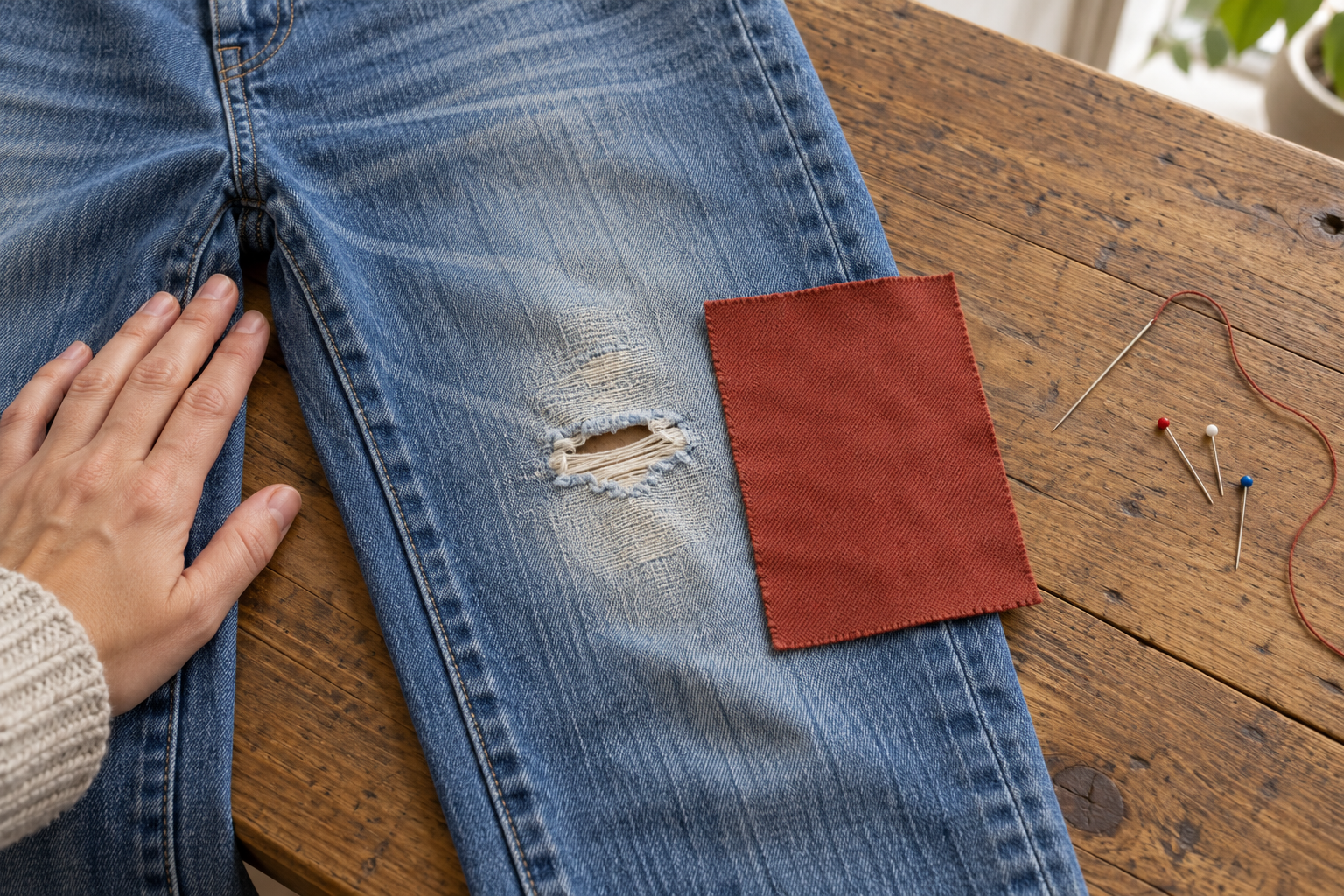
First find out what has failed. A pocket seam that has opened is a broken join between pieces of cloth. A thin patch at a knee is a damaged field of fabric; sewing only across the visible split asks the worn fibres around it to carry the same load again. The stitch path and backing fabric may need to extend into stronger cloth. In either case, the thread carries force from one part of the garment to another. The question is where it will transfer that force when the jeans bend, stretch, are washed and are worn again.
Thickness is a choice with a cost
Sewing-thread size is often expressed as linear density: more material per length generally means a heavier thread. A heavier thread can strengthen a test seam, but it also needs a suitable needle and makes a more visible, stiffer line. In a 2016 denim-seam experiment, researchers sewed four denim constructions with two threads and stitch densities. The stronger of their test threads gave stronger seams, while denser fabric and yarns made needle penetration harder. Their work describes new, controlled samples, not a guarantee that the heaviest thread will save a worn knee.
That distinction matters at the edge of a mend. A needle pierces the cloth each time it carries the thread through. Too many closely packed holes can leave a weakened strip where the repair ends. Too few stitches may fail to hold a patch flat or share a load. A 2021 study of denim seam strength tested different thread linear densities and stitches per inch on a specified denim and found that both variables affected strength in a non-linear way. The authors modeled those combinations for a manufactured seam. On an old garment, the cloth may be unevenly worn and its previous needle holes may already mark the path. The practical inference is to sample a small area and inspect the pull on the surrounding cloth, rather than chase the highest possible stitch count.
An earlier apparel seam study gives the broader reason: thread size, needle, tension, blend and fabric stiffness affect strength, puckering and drape together. Its samples were medium-weight suiting fabrics, so its numbers are not denim instructions. Its lesson about interaction is useful. A thread that behaves well in one fabric may pull another into a ridge. A thread that survives the pull test can still make a repair uncomfortable or too rigid at a place that must fold.
The cloth may stretch differently from the thread
Read the garment label and handle the fabric before selecting a spool. Some denim contains elastane and yields across the body more than a rigid cotton denim. A repair that cannot move with that cloth may either snap its stitches or put the motion into the surrounding fabric. Yet simply choosing an elastic thread is not a complete answer. In a 2022 study of stretch-denim seams, researchers compared elastic-core and regular polyester threads on four fabrics with elastane. Thread elasticity affected seam strength, but thread strength was the stronger influence in their tested combinations. Stitch type, density and the direction of the seam also changed performance. A repair should follow the way that part of the jeans moves, with a small test on an inconspicuous scrap or allowance where possible.
The direction of the denim weave matters as well. In the 2016 denim experiment, increasing stitch density raised seam strength in the tested warp and weft directions. In the 2022 stretch study, some weftwise chain-stitched samples performed better than other combinations. Neither result makes a chain stitch or a particular direction the universal winner for a hand repair. They show why a horizontal tear, a vertical seam opening and a diagonal worn area cannot be treated as identical mechanical problems. The thread holds a line of force; the weave tells it where that line leads.
Old jeans have a history
New repair thread joins cloth and older stitches that have already been through laundry, rubbing and perhaps deliberate finishing. In a 2018 denim-washing experiment, researchers tested denim with and without elastane, three thread constructions, and several wash processes. Seam strength was highest before washing and lowest after the more severe stone-and-enzyme treatment in their set; polyester filament produced the highest warpwise seam strength among their tested threads. A separate 2017 study of washed denim trouser legs measured lower thread tensile strength and elongation after its washing treatments. Those experiments cannot tell us exactly what one person's jeans have endured, but they explain why matching the colour of an existing seam is less important than checking whether its old thread and nearby cloth remain sound.
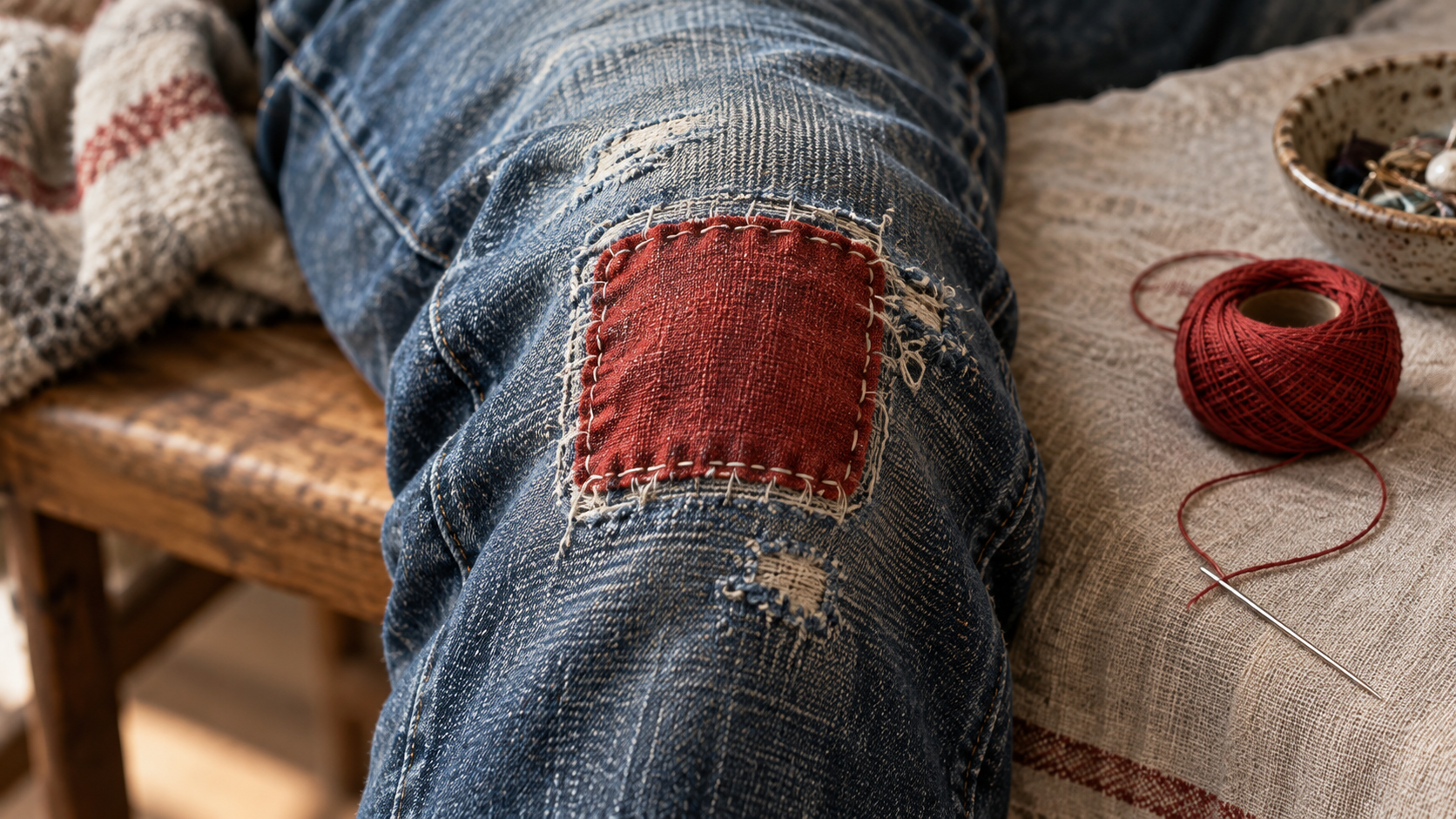
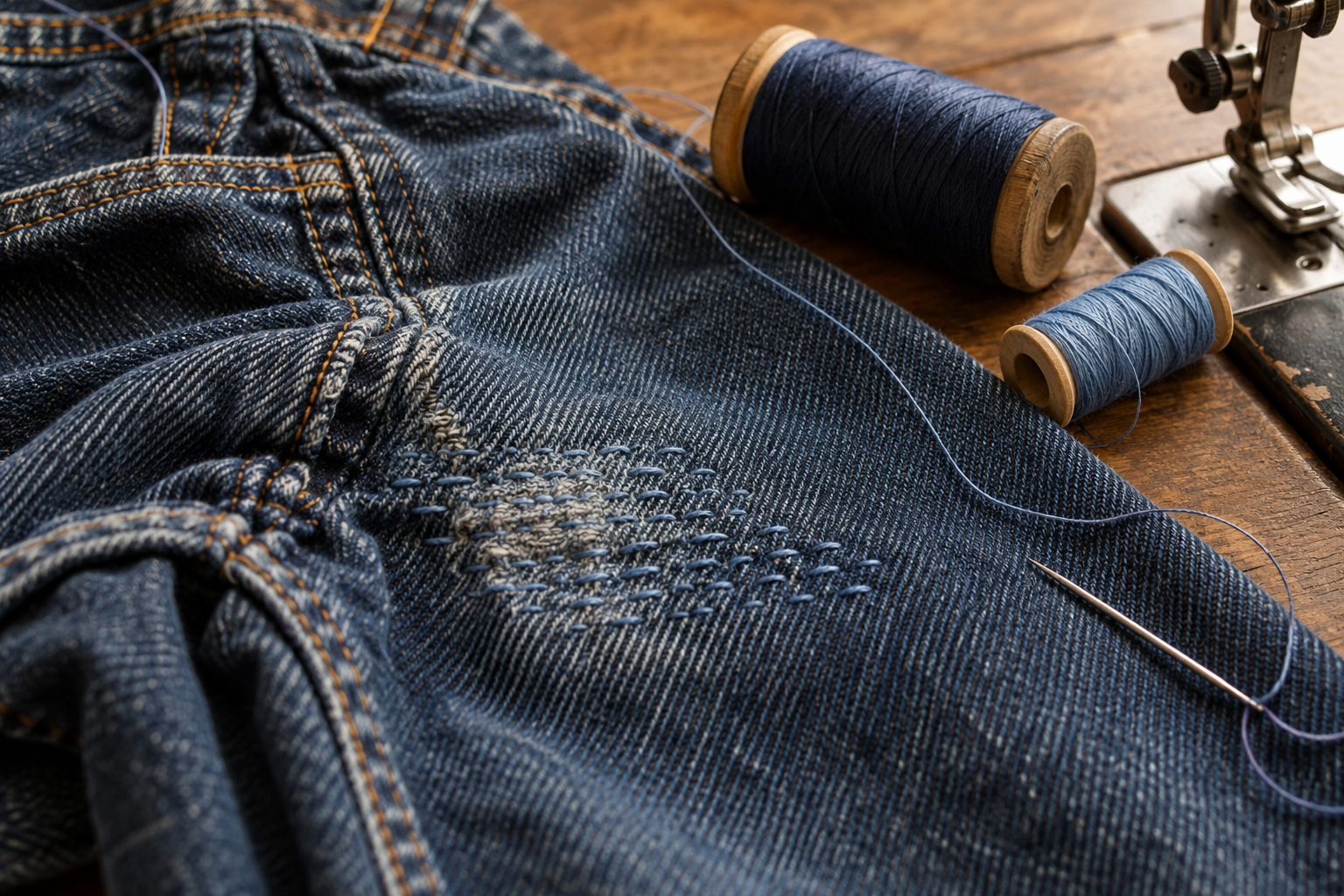
A new line of stitches sewn directly beside a fatigued old seam can preserve the original look yet leave the weak material between two rows to fail. Removing a broken stitch run, examining the cloth it passed through, and deciding whether the seam allowance still has enough body are separate parts of the job. If the cloth has thinned, a backing or a wider load path may be needed; thread alone cannot replace missing fibres. For a surface mend, the thread can secure the backing and distribute force through several modest lines instead of making a hard border around the hole. That is a repair judgment inferred from the way seams transfer load, not a tested prescription for every pair of jeans.
The visible line is part of the result
Matching thread can let the texture of the denim lead. A contrasting thread can make the repair legible and deliberate. Neither choice changes tensile strength by colour alone. What changes the garment's life is whether the stitch can move with the cloth and whether it remains comfortable against the body. At a high-wear point, a bulky knot or raised line may catch long before the fibres fail in a machine test. On a pocket edge, a thread close to the original diameter may help a repair sit beside an existing row without pulling the edge out of shape.
The useful final test is local. Work a short sample through the number of layers the repair will cross. If the needle struggles, the thread frays, loops form underneath, or the fabric puckers, change the combination before covering the whole area. Flex the finished mend by hand and inspect the cloth just beyond its stitches. After an ordinary wash, look again. A good thread is not merely unbroken at the centre of the repair; it has let the older denim remain intact around it.
A thought worth keeping?